Behavioral Neuroscience VI
How does our Brain process Physical Sensations?
Touch and Pain: How the Brain processes physical sensations
Sensations to Brain Signals
Before we can talk about our senses, we need to answer the glaring question: “How does a physical sense turn into something the brain can understand?” This is done through transduction, the process of converting energy/signal into an electrical signal that can travel through the nervous system to the brain. In essence, transmuting a stimulation into an action potential.
This is done by specialized cells that respond to outside stimulus by opening or closing ion channels. As we learned previously, this is how action potentials are created. Metabotropic Transduction is when an outside molecule, such as a smell molecule or a photon, binds to a receptor, releasing a G protein and opening ion channels. Ionotropic Transduction is when outside energy, such as heat or electricity, interacts with the receptor and opens the channel directly.
In both Metabotropic and Ionotropic Transduction, the larger the stimulus, the larger the response. The intensity of a response can be noted in several ways—either the neuron will fire multiple times, many neighboring neurons will fire at the same time, or the brain will interpret the range fractionation of the neuron. Range Fractionation is based on the idea that, while every neuron is “all-or-none” and therefore cannot demonstrate intensity in a single firing, different neurons will have different threshold for firing—a neuron with a high threshold will indicated a high intensity. Neurons that respond quickly to outside stimuli are called phasic, and those that are slow to respond are called tonic.
Another important concept to understand is Adaption: the progressive loss of response to a maintained stimulus. Adaption is the reason that you don’t feel your clothes against your skin all the time—your body simple stops responding to such a consistent feeling. Another interesting effect of stimulus is that when a neuron fires due to a stimulus, it inhibits the surrounding area. This makes the neurons signal even more pronounced, and makes sure that the neighboring neurons only fire if there is an even stronger stimulus against them.
Some cells, called Polymodal Cells, respond to more than one sense. Synesthesia is when stimulus from one sense creates sensation in another—like seeing color with music.
We will explore how each sense uses transduction and how the brain processes each sense individually very soon—but first we ware going to talk about somatosensation: signals related to touch, proprioception, and pain.
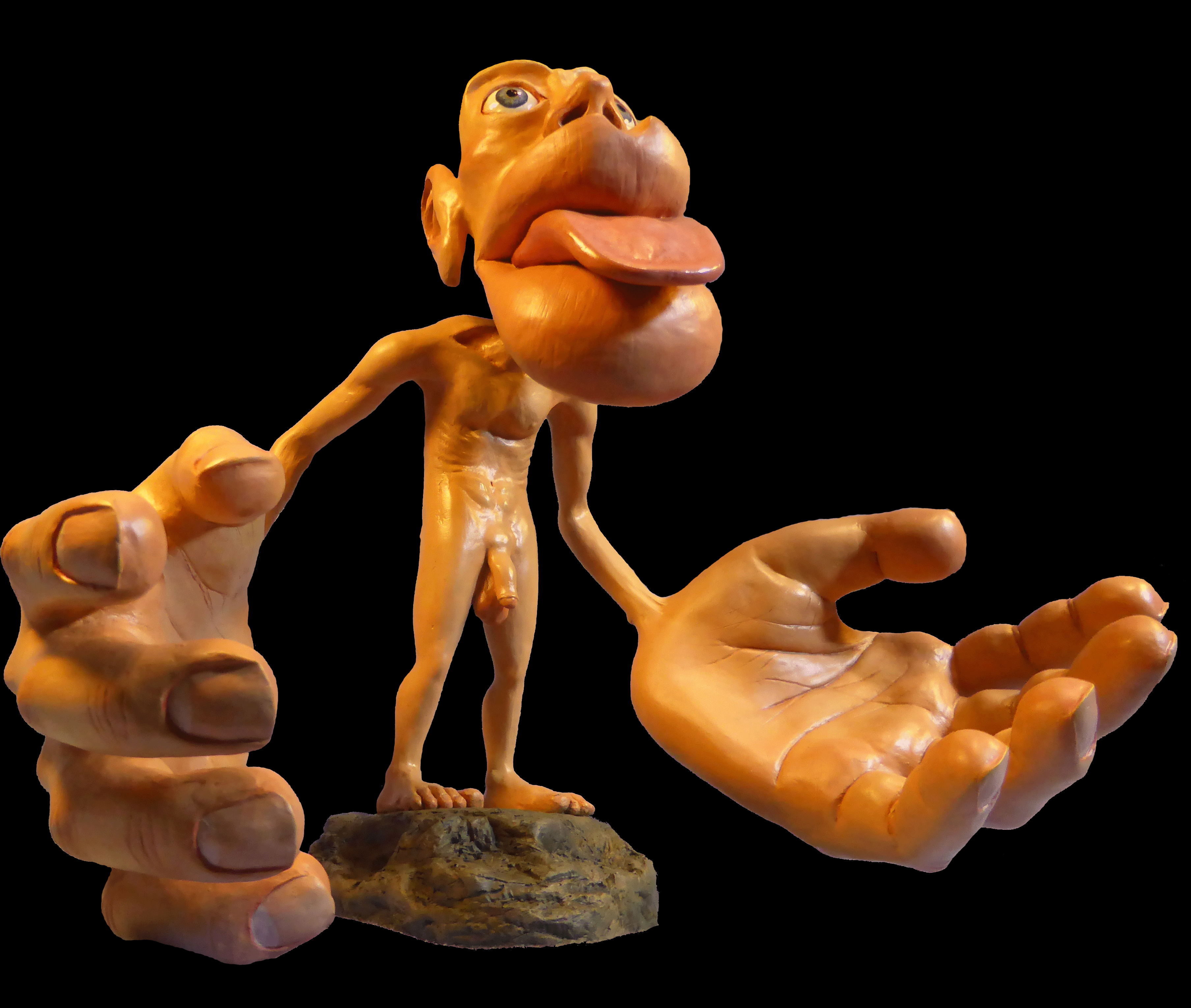
All somatosensory signals are sent up the spinal cord to our brain and mapped onto a 2-D sheet of grey matter in our primary sensory cortex. More sensitive areas of the body have more sense receptors and therefore take up a larger part of the brain. The Homunculus is a terrifying personification of how our brain interprets somatosensation—you can see that our hands, feet, and lips are huge emphasis and our back has very little.
If a body part or the nerves connected the body part to the brain are removed, the brain region associated with that body part will shrink. Neighboring sensory brain areas will begin expanding into this freed up space, given these growing regions more refined sense interpretation. The brain’s ability to change is called Cortical Plasticity.
Phantom Limb is the phenomena in which a person feels like their missing body part is actually there – this is due to the cortical area previously associated with the body part is being stimulated the encroaching cortical regions, but the brain is still attributing it to the old body part.
Somatosensory Signals

Touch is (obviously) the sensation you feel when something applies pressure to your skin. First, think of how cool it is that by pressing on your skin, you are creating action potentials in touch receptors. You have four different touch receptors that serve different purposes:
- Deep, large, and phasic receptors (Pacinian Corpuscle) that communicate vibration and heavy pressure
- Deep, large, and tonic receptors (Ruffini’s Endings) that communicate stretching
- Shallow, small, and phasic receptors (Meissner’s Corpuscle) that communicate texture
- Shallow, small, and tonic receptors (Merkel’s Disc) that communicate light and constant pressure
Proprioception is the sensation of where your limbs even when you can’t actually see them—it’s how your muscle’s “feel”. Golgi tendon organs measure muscle tension/contraction and muscle spindles measure length and change. Limb position is compared in the brain to the limb’s neutral position, which is set by Gamma motor fibers.
Pain, according to the International Association for the Study of Pain, is defined as “an unpleasant sensory and emotional experience associated with actual or potential tissue damage or described in terms of such damage.” Pain and temperature are detected by nociceptors, free nerve endings, and there are three types:
- TRPV1 receptors detect painful heat and capsaicin, the chemical that makes food spicy, and respond slowly
- TRP2 receptors detect quick sharp pains that cause immediate reactions
- CMR1 detect cold and respond slowly
Nociceptors respond to the chemicals released by tissue damage. The dull, aching pain of TRPV1 and CMR1 receptors travel up slow, unmyelinated C fibers. The sharp pain of TRP2 receptors travel up large myelinated A-delta fibers.
Pain inhibition is our brains ability to block incoming pain signals. As pain signals travel up the spinal cord and enters the brain, they pass through Periaqueductal Grey Matter (PAG), which is (potentially) brain area responsible for pain inhibition due to PAG being rich in opiate receptors. As the pain signal passes through PAG, the opiate receptors release endorphins, which in turn activates the release of 5-HT to spinal cord nerves, inhibiting/blocking the incoming action potentials.
Many pain relief treatments use this opioid effect to reduce pain. Rubbing wounds/bruises helps by sending more pain signal through PAG, increases the endorphin response. Acupuncture and TENS both also work by inducing a larger endorphin response due to increasing pain slightly. Because tissue inflammation/damage is what causes nociceptors to fire, anti-inflammatory agents can also help reduce pain.
Recap:
- Electrical signals are created from outside sensations through a process called Transduction
- Touch & Pain are sensed by either external pressure against the body or tissue damage within the body
- Natural pain reduction is caused by endorphins released when a pain is experienced, which actually blocks pain signals from enter the brain