Behavioral Neuroscience XII
Why do we Sleep?
Sleep
Sleep is still mostly a mystery to modern neuroscience. Despite constituting a huge portion of our day, we still do not know why we sleep, why we dream, or why some people need less sleep than others. After a decades long study involving hundreds of participants, one sleep scientist concluded that the only discernable reason we sleep is “because we get sleepy.” Despite this, below are the things we do understand about sleep.
Circadian Rhythm
Our body has several kinds of rhythms on different timers. There are ultradian rhythms (shorter than a day, like eating) circadian rhythms (about one day, sleeping), infradian rhythms (more than a day, menstrual cycle) and circannual rhythms (about one year, coat color in foxes). Sleeping is on a circadian rhythm.
Left with no time cues, animals will typically free run, meaning they go to bed about 1 hour after they did the night before; this leads us to believe the sleep cycle is about 25 hours long. This cycle seems to be regulated by the Suprachiasmic Nucleus (SCN). The SCN is located above the eye has about a 24 hour long neural activity. While it unclear exactly how the SCN causes sleep, damage to the SCN leads to a damaged circadian rhythm, and even without neural connectivity the SCN enforces the circadian rhythms.
The rhythm of the SCN is created by a cycle of Clock-Cycle proteins and Period-Cryptochrome (Per-Cry) genes. As Clock-Cycle proteins build up, they promote the Per-Cry genes, which inhibit Clock-Cycle from promoting Per-Cry. As Per-Cry promotion grows it inhibits its own expression. This was a very confusing sentence pretty much saying that Clock-Cycle and Per-Cry cycle back and forth as being expressed/inhibited by each other, and this process takes about 24 to repeat.
Visual stimulus has large effect on the SCN, and therefore our sleep cycle. The SCN receives input from the retina, which promotes the transcription (expression) of the Per gene. This means that visual input has a profound effect on our sleep cycle, and why looking at bright lights before bed is makes falling asleep more difficult.
Sleep
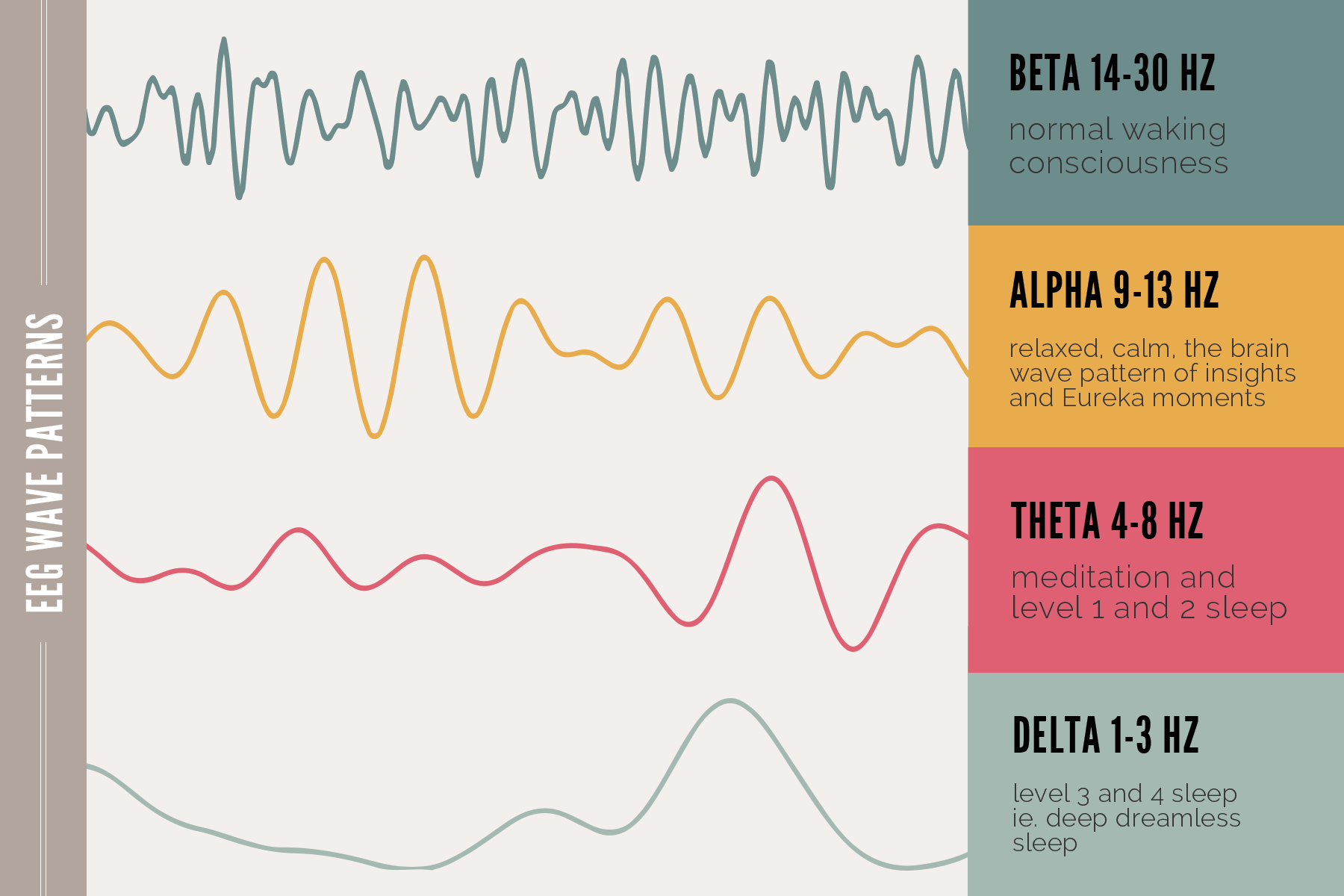
Our sleep goes through cycles:
- When we are awake, our brain waves are above 20Hz and desynchronized
- Slow Wave Sleep (SWS) is comprised of four stages:
- Stage I: 9 – 12 Hz brain waves (called alpha rhythms)
- Stage II: 12 – 14 Hz brain waves
- Stage III: Large, slow, delta waves. Occurs early in sleep
- Stage IV: Dominance of delta waves. Occurs late in sleep
- Rapid Eye Movement (REM): Relaxed muscles and rapid eye movements. This is where dreaming happens, and we actually look awake on an EEG
Sleep cycles last about 1.5 hours, going through each stage again. Later sleep cycles skip stage III and stage IV of SWS and instead go straight to REM. REM sleep occurs multiple times each night, and lasts about 100 minutes. Early REM is tied to the days events, and later ones are ‘thinking dreams.’
We tend to sleep and dream less as we get older, and teenagers tend to go to bed later/ wake up later than adults. Humans actually need very little sleep in comparison to most animals.
Recap:
- Sleep is runs on a 24 hour cycle regulated by the SCN.
- Sleep, for the most part, is still a mystery