Behavioral Neuroscience IV
How do Drugs affect our Brain?
Psychopharmacology: How Drugs affect the Brain
Pharmacology is the attempt to influence biological systems (and their disorders) with drugs, and so psychopharmacology is the attempt to assuage problems found in mental systems with drugs. We will first discuss the different compounds and pathways present in the brain, and then talk about the effects common drugs have on these pathways.
Common Neurotransmitters
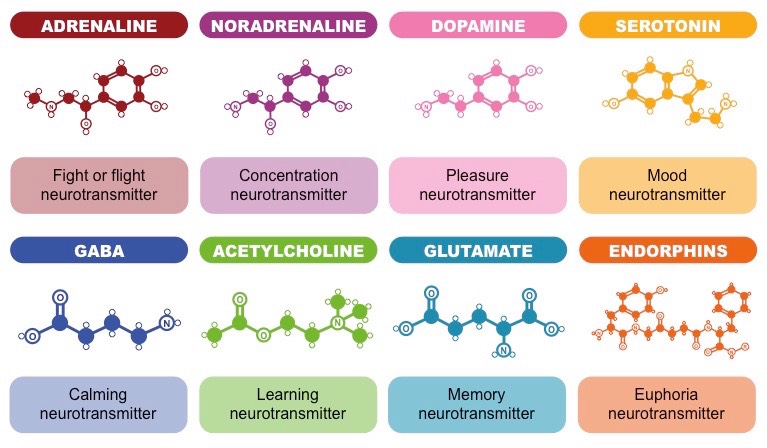
Acetylcholine (ACH) is integral to the “rest and digest” response in the Parasympathetic Nervous System. Triggers actions such as the slowing of heart rate and increased intestinal/gland activity. Found in the chologinergic pathway of the brain involving the cortex, hippocampus, and cerebellum. An imbalance in ACH levels has been linked to Alzheimer’s Disease.
Dopamine (DA) is involved in our reward system and movement. These two functions are quite diverse, and so DA emerges from two different pathways in the brain: the DA movement pathway found in the substantia nigra and basal ganglia, and the DA reward system pathway passing through the ventral tegmental area (VTA) and the limbic system. A surplus of DA has been linked to schizophrenia, and a scarcity of DA is linked to Parkinson’s Disease. Due to its close relation with the reward system, large dopaminergic responses to a drug/stimulus/behavior is often a major sign of addiction.
Norepinephrine (NA) is responsible for our mood, behavior, sexual impulses, and anxiety. Found in the noradrenergic pathways originating in the brain stem.
Serotonin (5HT) is involved in regulating sleep, mood, sex impulses, and anxiety. Because of its diverse functionality, it is found throughout the brain. The term monoaminic transmitter or monoamine typically refers to DA, NA, and 5HT.
Glutamate is the most common excitatory neurotransmitter. The most common glutamate receptors are AMPA, Kainate, and NMDA receptors. GABA is the most common inhibitory neurotransmitter. The most common GABA receptors are GABA-A, GABA-B, and GABA-C (creative names).
Drugs
Antidepressants work by accumulating monoamines and prolonging their activity. There are three kinds of antidepressants:
- Monoaminic oxidase inhibitors (MOAIs) work by preventing the breakdown of monoamines, increasing the amount found in synaptic vesicles
- Tricyclic Antidepressants block the reuptake of NA and 5HT, increasing the amount available
- Selective Serotonin Receptor Inhibitors (SSRIs) allow 5HT to accumulate in synapses. This is the currently the most common form of antidepressant—Prozac and Zoloft are SSRIs
Amphetamines boost the excitatory effects of neurotransmitters by blocking reuptake:
- Cocaine blocks monoaminc transporter proteins and slows reuptake, increasing their effects. This blocking causes the degradation enzyme to reduce in effectiveness even after the immediate high has worn off.
- Caffeine blocks adenosine receptors, a neurotransmitter that makes you sleepy. Interestingly it is both an antagonist because it blocks adenosine and also an agonist by allowing normal transmitters to continue.
Alcohol depresses and lower inhibitions by activating GABA-A receptors. It also depresses activity in the cerebellum (motor coordination) and the dopaminergic pathway (stimulation and reward).
Opiates typically reduce the emotional response to pain by mimicking proteins such as endorphins and dynorphins. Endorphins are released when you exert excess energy, and are the cause of the “runner’s high” people get when exercising.
Hallucinogens often influence our interpretations of sensations, and effect synapse efficiency even after “trip” is over:
- PCP and Ketamine are antagonists for NMDA receptors and stimulate DA release.
- LSD and Psilocybin stimulate excess 5HT release. MDMA increases 5HT levels and triggers DA release as well.
- Marijuana modulates glutamate release.
Nicotine is an agonist for ACH in the reward system. This increases heart rate and blood pressure, and the ability to take multiple short hits in rapid succession makes it addictive.
Tolerance, or the lack of effectiveness of a substance after prolonged use, is a common attribute of drug use. There are multiple kinds of tolerances. Drug Tolerance is the most straight forward, in which each successive treatment has a decreasing effect. Metabolic Tolerance is when the liver becomes better at inactivating/eliminating the drug. Functional Tolerance is when the target tissue responds to treatment and reduces sensitivity—either Down-regulating, decreasing number of receptors in response to an agonist, or Up-regulating, increasing the number of receptors in response to an antagonist. Cross-Tolerance is when tolerance of a chemically similar drug decreases the effectiveness of a treatment. Addiction is often caused by a dopaminergic response in the reward system.
Recap:
- Acetylcholine, Dopamine, Norepinephrine, Serotonin, Glutamate, and GABA are the most common neurotransmitters
- Drugs work by influencing the production, release, or degradation of these neurotransmitters