Behavioral Neuroscience V
How does our Brain communicate with the body?
Hormones: Brain-Body Communication
Up to this point, we know that neurons communicate information by passing action potentials via neurotransmitters from synapse to nearby dendrites (If you can understand that sentence, you are on top of this material!). But there are other ways to pass information everywhere. Hormones are things that your body releases into your blood stream to send transmitters all over your body. This is done by neurosecretory neurons: neurons that, instead of having synapses connected to other neurons, have synapses connected directed to the blood stream that release hormones. Endocrine cells release hormones into the bloodstream, and Exocrine cells release hormones “outside the body” to places like the skin and gut.
(Disclaimer: Ignore the following list of hormones until later when we start referencing hormones by group and we have a better understanding of what each hormone does. Just understand the general groupings)
There are multiple kinds of hormones:
- Protein/Peptide hormones are strings of amino acids, examples include ACTH, FSH, Growth Hormone, Insulin, Oxytocin. Peptide hormones can’t pass through the oil cell membrane, so they rely on a second messenger such has cAMP or cGMP to convey their message inside the cell.
- Amine Hormones include Epinephrine, Norepinephrine (a neurotransmitter AND hormone), thyroid hormone, and melatonin.
- Steroid hormones include gonadal hormones like estrogen and progestogen and adrenal hormones like cortisol. Unlike peptides, steroid hormones can pass through the cell membrane and bind to receptors inside the cell. Because of this, they can act as a transcription factor by having influence on gene expression. This makes their effects slow but long-lasting.
Hormones are regulated different negative feedback loops, meaning that the more of a hormone is present, the less it is produced. A system like this can be built with Autocrine Feedback, where the hormone itself inhibits the production of more hormone, or Target Cell Feedback, where a secondary cell overproduced because of the presence of a hormone inhibits the production of more hormone.
The ultimate controller of all feedback loops is the Hypothalamus. The hypothalamus controls most of the endocrine system and it’s main glands: pituitary, pineal, pancreas, and gonads. Each gland has its own set of hormones it can release.
Glands
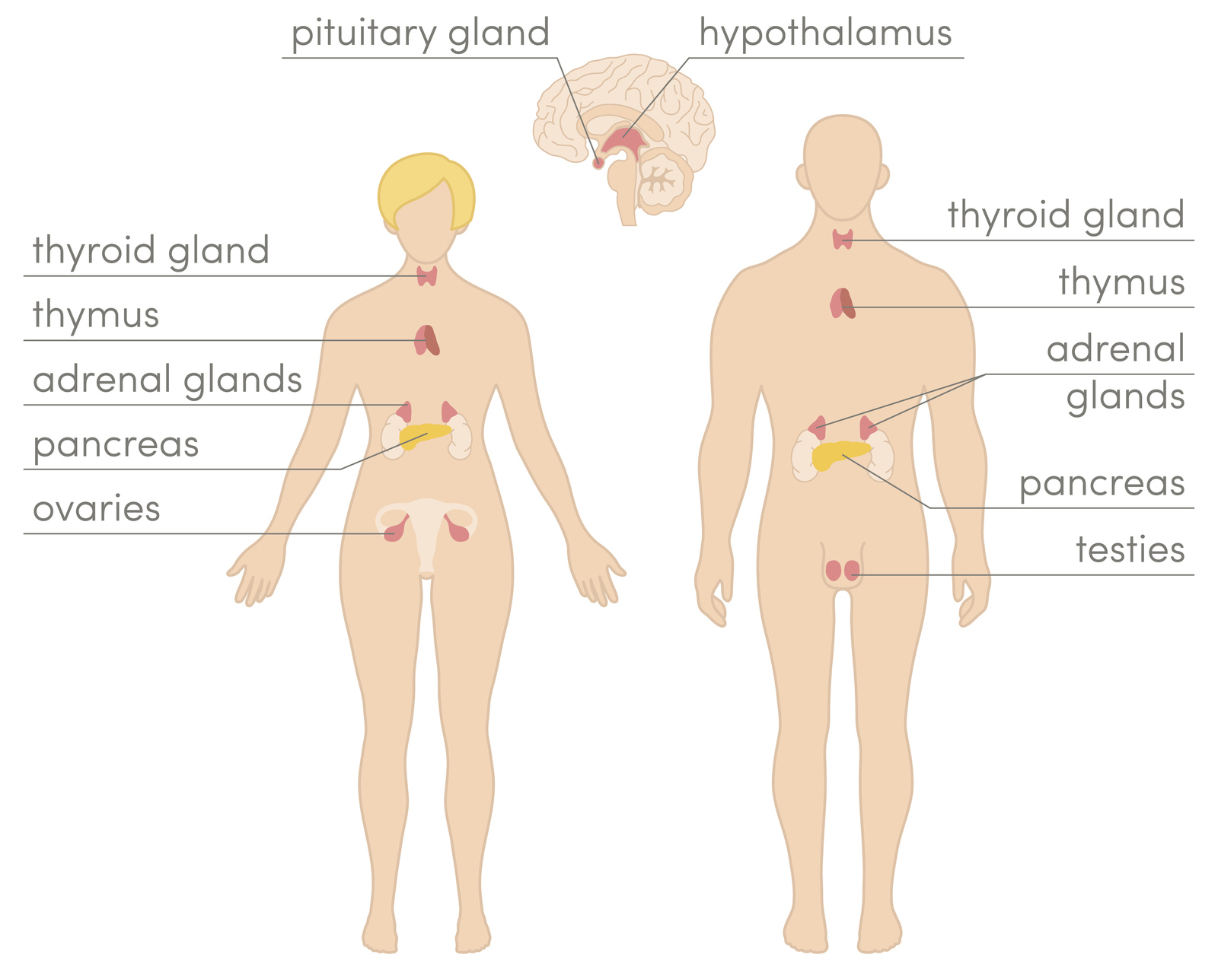
The Pituitary Gland is directed below the Hypothalamus and is actually split into two different glands: Posterior (back) Pituitary and Anterior (front) Pituitary.
The Posterior Pituitary is connected directly to the Hypothalamus through long neurons/axons called pituitary stalks. It releases two hormones: Vasopressin and Oxytocin. Vasopressin acts on the kidney to conserve/regulate water in the blood by inhibiting the formation of urine. Oxytocin in females is released during childbirth to stimulate contractions and triggers milk letdown during nursing. Interestingly, it is released when hearing a baby cry and during orgasm, so it is theorized to promote bonding… sometimes it is called the “Love Hormone.” Outside of these instances, research also shows the Posterior Pituitary is important for bonding: Oxytocin promotes pair-bonds in females, and Vasopressin promotes pair-bonds in males.
The Anterior Pituitary is connected to the Hypothalamus through a system called portal circulation, where neurons from Hypothalamus dump compounds into blood stream that leads directly to the Anterior Pituitary. It releases Prolactin, which stimulates lactation, and Growth Hormone (GH) which is mostly released during sleep and influences growth. In addition to these hormones, the Anterior Posterior releases four trophic hormones, or hormones that affect other endocrine glands. These are:
- ACTH: Controls the production/release of steroid hormones in adrenal cortex
- Thyroid-Stimulating Hormone (TSH): controls thyroid hormones
- Follicle-Stimulating Hormone (FSH): stimulates the production of either sperm or egg follicles
- Luteinizing Hormone (LH): Stimulates either testosterone from testes or eggs follicles to form
Gonadal-Releasing Hormone (GnRH) is dumped into the blood by the Hypothalamus and is what causes the Anterior Pituitary to release LH and FSH. Oral birth control works by blocking the release of GnRH, which prevents LH and FSH from being released, which prevents an egg from entering the ovaries.
The Adrenal Gland is located on top of each kidney. In response to ACTH releases adrenocorticoids (hormones released by adrenal gland). Glucocorticoids increase glucose in the bloodstream. Mineralocorticoids help retain sodium and water in the blood. Sex steroids, as the name suggests, increase energy and sexual drives.
The Pineal Gland is a tiny gland at the top of the brainstem. It releases melatonin at night, an amine hormone the regulates sleep.
The Pancreas sits right behind the stomach and is actually controlled by the Vagas Nerve, not the Pituitary/Hypothalamus. It releases two competing hormones: Insulin, which decreases blood sugar in anticipation of a meal, and Glucagon which increases blood sugar afterwards.
Sex and the Brain

This is not a sex-ed recap, but rather a quick look at the effects of sex hormones on the nervous system and body. Despite the potential, talking about sex in behavioral neuroscience is not as sexy as one would hope.
First, sex is determined by the Sex-Determining-Region-of-the-Y-chromosome (SRY), which causes cells in the medulla to development into testes and promote male development. In absence of a Y chromosome and SRY, cells in the cortex will become ovaries instead.
There are some neurological differences between sex as well. Male brains have motor neurons dedicated to ejaculation while female brains have motor neurons dedicated to contraction. The hypothalamus is also shown to statistically different between males and females.
Estrogen and Testosterone are crucial to sexual behavior and organization. Developing testes produces testosterone and anti-mulleran hormone (AMH) which in absence of allows the created of fallopian tubes. A lack of testosterone abolishes male copulating behavior, but a large influx does not increase sexual arousal or performance; a very little is enough, more is not better. Estrogen production leads to ovulation as well as Lordosis, or as a neuroscience professor explained to me, the “head down, ass up” response.
On sex itself: Human sexual response consists of four stages: excitement, plateau, orgasm, resolution. Men have only one site of erection, while women have many (breasts, nipples, clitoris, etc.). Males generally have a single brief orgasm followed by a refractory period lasting minutes to hours, while women can have several orgasms in a row. Sexual arousal is mediated by the parasympathetic system, and ejaculation is mediated by the sympathetic.
Recap:
- The brain, specifically the hypothalamus, communicates with other parts of the body through hormones. Hormones travel through the bloodstream and are regulated through negative feedback loops
- Hormones regulate a multitude of things, from water retention to hunger to (potentially) love