Behavioral Neuroscience VII
How do we Hear? Or Balance?
The Ear: How Hearing & Balancing Work
Disclaimer: Understanding how the ear works is really hard without a anatomical vocabulary. This is because the ear has so many tiny parts are just a bunch of weird shapes. Ears are weird. There are a lot of parts to the ear, so I have narrowed it down just enough for us to understand how hearing works without being overwhelmed by vocab. Hopefully.
Hearing
Before we talk about hearing, we have to talk about sound. Sound travels in waves at a frequency, which is cycles per second—how many times the waves goes up in down in a second. The goal of the ear (and hearing) is to capture these frequencies, from a bunch of different sources, and translate them into action potentials so our brain can interpret them.
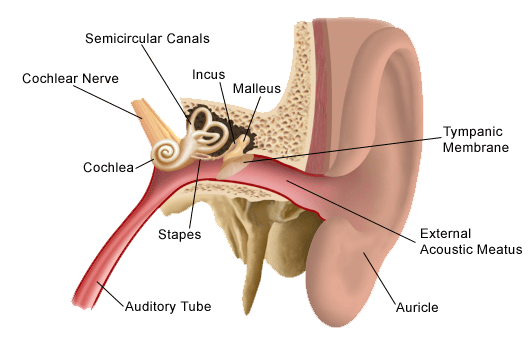
When a sound passes enters your ear, it goes through its three parts: the outer ear, middle ear, and inner ear. The outer ear is what most people who considered the whole ear—it is the only visible part. It is shaped so strangely because this shape helps to collect and filter sounds, which is important for sound localization, figuring out where sounds originated. One example of sound localization is how your auditory cortex understands that while it may hear a sound each from every direction, a sound is loudest in the direction it is truly in.
The sound then travels down your ear canal and hits your ear drum, a membrane covering the entrance to the middle ear. The ear drum vibrates differently depending on the frequency of the incoming sound. This vibration causes 3 small bones, called ossicles, to tap against the entrance of the inner ear at the same rate… it’s almost like Morse Code.
The inner ear is made of the cochlea and the semicircular canals. The cochlea is a swirly shaped structure that the ossicles are tapping against. Inside the cochlea are series of canals lined membranes, which are filled with a K+ rich liquid called endolymph. Inside the cochlea’s middle canal is the organ of corti, where hearing’s transduction takes place.
The Organ of Corti is a tiny structure with rows of hairs called stereocilia, with 12,00 hairs on the outside and the 3,500 inside. The bending of the stereocilia one way causes connected K+ channels to open, allowing the K+ from the endolymph to flood in a depolarize the hair neuron. Bending the hair the other way causes the K+ channels to close, polarizing the hair neuron. This depolarization activates Ca++ channels, which in turn releases glutamate down the auditory nerve, a nerve leading from the inner ear to the brain made up of 35 – 50,000 nerve fibers. Each inner hair cell is connected to approximately 20 different neuron dendrites. In this way, frequency is converted in an action potential.
The auditory cortex, the final destination of the auditory nerve, is quite similar to the somatosensory cortex as discussed previously. We even have a surface mapping sounds—a tonotopic arrangement.
While being far less in number, the inner hair cells are the ones literally responsible for hearing—the outer hair cells simple help to amplify sounds that enter the cochlea. Frequency is also determined by the outer hair cells, as high frequencies stimulate hairs near the base of the cochlea while low frequencies stimulate hairs much farther back. When you hear a loud noise or listen to loud music, hair cells start to die—and loss of hair cells is permanent!
If you lose enough hair cells, you can go deaf or become hard of hearing. Cochlear implants help fight deafness by stimulating the auditory nerve in multiple (6 -32) places, providing the user with more tone frequencies to utilize.
Balance

Hearing and balance were grouped together because both senses are found in the inner ear. While hearing is centered around the cochlea, balance is found in the semi-circular canals. The semicircular canals are three paired canals that sit are 90 degrees to each other, corresponding to all three dimensions. Each canal has hair cells in pockets of space filled with a gelatinous mass called cupulla. Just like hair cells in the ear, these hair cells bend as the liquid around the moves, causing K+ channels to open. It should be noted that ear hairs do not fire the action potentials themselves, they open gates that allow secondary cells to fire. These hair cells are connected to cranial nerve VIII, which is made up of 20,000 cells, which leads into the brainstem.
Recap
- Sounds vibrate the inside of our ear, causing our ear hairs to shift back and forth and fire action potentials
- Our sense of balance comes from a different set of hairs inside the ears that shift as the fluid around them moves