Behavioral Neuroscience II
How does our Brain grow?
Development: How Brains Grow
Brain Evolution
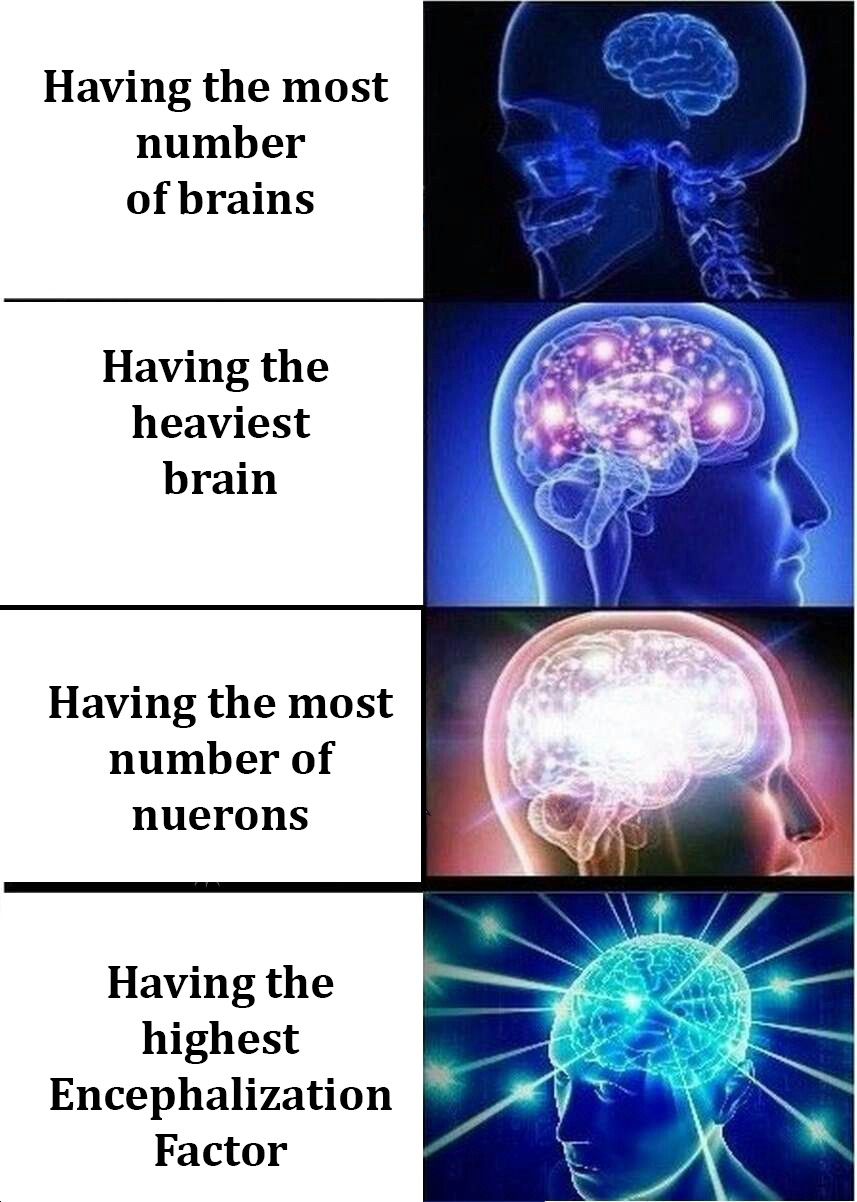
First, before we discuss how our brains develop, we should answer the question: Why are our brains so special? Why are human brains so much better than other animals? Answer: We are not Special. Human brains are not as special as we like to think…
- Humans share very similar brain & brain cells structure as most vertebrates
- Humans share ~ 98.5% of our DNA with chimpanzees… and 60% with bananas
- Humans don’t have the biggest brains (whale)
- Humans don’t have the heaviest brains (also whale)
- Humans don’t have the most brains (leeches, with 32!)
- Humans don’t have the highest brain-to-body ratio (ants, shrews, and small birds all have 10 times higher ratios)
- Humans don’t have the most neurons (Octopi have 5x neurons on us)
- Humans don’t have the most synapses (Elephants)
What we do win at is the Encephalization Factor, which is “the ratio between actual brain mass and predicted brain mass for an animal of a given size.” (I think it was made up to help human brains win at something…)
Most big differences between species’ brains are due to an individual species adapting to their environment. Animals that rely heavily on sense of smell have much larger/complicated olfactory brain regions, those that rely on hearing have larger hearing brain regions, etc. We rely on our vision quite a lot, so we have a very large visual system. What we also have is a very large critical thinking area of the brain– unmatched in the animal kingdom. Current theories as to why this adaptation occurred (and this is still a hotly debated topic) is because Humans are incredibly social creatures, and socializing is a complicated process that requires a large amount of critical thinking power behind it. This push to be social early in our evolution may explain why our brains are the way they are.
Brain Development
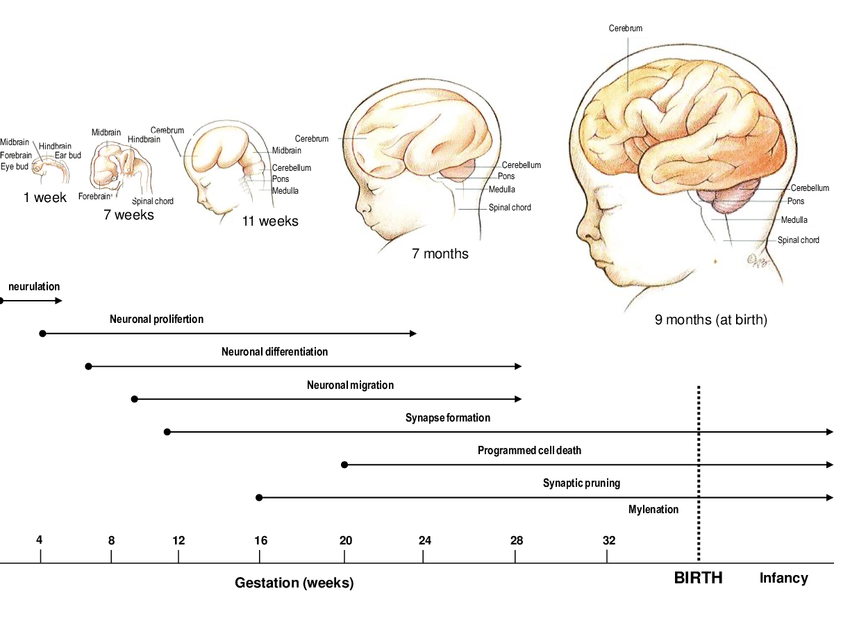
Humans start off as a zygote, or fertilized egg, and then grow into a blastocyst, or ball of dividing cells. Blastocysts can be generally broken down into three cell layers and one of these layers, the Ectoderm, will develop into the Brain and nervous system. From this step there are six stages of brain development, each covered below:
- Neurogenesis: Brain cells are produced from stem cells and group together in the ventricular zone
- Cell Migration: Brain cells start to move away from the ventricular zone by crawling up radical glial cells which act as “ladders” spanning the length of the cortex. Brain cells start forming layer on top of layer until there are 6 layers of cells
- Differentiation: Cells start to specialize into neurons or glial cells. Unlike animals with a smaller number of neurons, Human neurons maintain a more flexible differentiation is determined by cell-by-cell interaction, or the influence of a cells specialized function on its neighbor’s decision. This is partially why brain imaging/procedures/etc. are hard to generalize—everyone’s brain regions are slightly different in size/shape
- How do neurons know where they are in the brain? No definitive answer Current theory is that growth cones, found at the tips of axons, grow towards chemoattractants released by nearby cells of a similar system. In this way they understand how close they are to a particular system, and specialize to this degree; the closer they are to the heart of the system, the more they specialize
- Synaptogensis: Synapses between neurons start to rapidly form in the largely unwired fetal brain. Nerve cell bodies increase in size to support the growing synapses
- Apoptosis: Dramatic, but normal, guided cell death. 20 – 80 % of cells die; your body simply doesn’t have enough Nerve Growth Factor (NGF) to support that many brain cells. NGF is simply the name for substances needed for cells in the nervous system to grow. Apoptosis should not be confused with Necrosis, which is cell death caused by lack of NGF seen in malnourished fetuses, which is more severe and uncontrolled.
- Cells have death genes that become expressed during apoptosis. This expression is first triggered by an influx of calcium into cell, which leads to the release of the Diablo protein from the Mitochondria. Diablo inhibits IAPs, Inhibitor Apoptosis Proteins, which then triggers the activation of Caspases, proteins that rip apart DNA and proteins, which signals the beginning of apoptosis.
- Synaptic Rearrangement: Remaining neurons stake advantage of newly opened synaptic space to create more complex connections. Since the connections that survive apoptosis are the most important, while neuron density falls during development, neural activity stays constant. Throughout these 6 steps myelin is being formed around important axons. Sensory zones are myelinated before motor zones, leading to quicker sensory processing than motor control as a baby.
Recap
- The Human Brain has no obvious advantage over other brains. The differences may simply be because humans evolved to be social, and socializing is very complex
- Our brain develops by producing layers of neurons, which soon specialize to a flexible purpose. We then cut out the superfluous neurons to allow the important neurons build more connections